


INFRINGE Magazine: Devil’s Dolls
EDITORIAL: Kei Takano and Sabrina Bonatesta arrange a collection of alt-goth dolls, captured by Ralph Whitehead
Creative Direction: Sabrina Bonatesta
Hair: Kei Takano
Photography: Ralph Whitehead
Styling: Rubina Marchiori
Makeup: David Gillers
Creative Assistants: Samuel Coviello + Ako Suzuki
Styling Assistant: Erica Welhenage
Models: Jundan at Anti Agency, Molly, + Saffron
Fashion: BE NINA

METAL Magazine - a Maximalism Pursuit of Youth and Rebellion
A white platform stacked high with black bows and crocheted green and pink flower motifs, Be Nina’s shoes look like a deconstructed cake for a teen and upcoming goth girl in the noughties – very Avril Lavigne, very delicious. The Be Nina girl is at the cusp of adulthood, youthful in her sartorial rebellion clad in Lolitaesque crochet dresses and bows that scream girlhood, paired with overdrawn glittery and black eyeliner that adds to her aura of disgruntled ennui.
Clutching on to elements of cuteness and the supposed innocence of childhood through toys in her headbands and cat-like features in her hats, Sabrina Bonatesta of Be Nina is quite influenced by the maximalism of Japanese streetwear. The designer’s first showcase at Graduate Fashion Week in 2019, giving dark lace and colourful crocheted personalities to young tea drinkers, earmarked her as one of UK’s emerging designers by Vogue Talents. The structure in her school uniform pieces for F/W23, breaks down completely in her more layered crochet mismatched dresses. Showcasing as a sustainable designer a couple of years ago at Milan Fashion Week, Sabrina is now looking once again to draw us into her soft, doll-like world of animals, childhood, and days that are bygone which we still cling to — who doesn’t like the schoolday’s Mary Jane, but with a red heart sole? She is due to show her next collection the end of March.
What was your experience as a design student in London? Did you always want to open your own brand?
Studying in the UK was the best decision of my life, London sparked my creativity in ways I never could have imagined. Everything felt new and unfamiliar, almost like being a child again, I felt reborn. I fell in love with the underground scene. I never dreamt about studying fashion, nor was it something I actively pursued. I wanted to study architecture in Rome but in 2014, I took a short summer course at West London College because my parents thought it would be a good way for me to learn English. My course teacher told me I had to continue studying fashion, so I did. After university, I wanted to work for other brands, and I had three dream companies and I even got an interview with one of them. It felt surreal. But then, February 2020 happened, and suddenly, I had no job. I moved back to Puglia and Be Nina was born. It's interesting how life's disruptions can redirect us.
You used to work earlier in between London, Paris and Milan – do you still do that, or are you mostly in Puglia?
I used to work full-time in those cities for other brands, but now I’m fully dedicated to Be Nina and spend most of my time in my studio in Brindisi. I still travel frequently to London, Paris, and Milan – sales, shoots, meetings. Occasionally, I do consultancy work for other creatives. I also visit them to see museums, since there aren’t many in Puglia. Working from Brindisi helps me stay connected to the regional craftsmanship and materials, which define my brand.
What influences you in design? Looking at your work, I would have said Westwood.
I only discovered Vivienne Westwood in my second year of university as everyone was talking about her and McQueen. I became obsessed. The same with John Galliano, he remains my forever artistic muse. I love the Miu Miu girl aesthetic, every time I design something new, I ask myself, Would this be okay for Miuccia? But my first love is a past brand called Meadham Kirchhoff. I love their youthful, rebellious spirit and high-energy shows. My influences also come from subcultures, the British New Romantics, punks, goths, Japanese Lolitas, and Moe anthropomorphism. Of course, I take from traditional Italian dress and antique Victorian children’s clothing and nightwear and also, antique toys—anything cute yet slightly destroyed. That contrast of the delicate and the undone is something I always try to capture.
What made you get into the street culture of Japan? Looking at some of the makeup in your shows and photoshoots, it reminds me of FRUiTS, which used to be published.
That’s absolutely correct! While at university, I discovered FRUiTS. My friend Geneva always carried that book with her, along with Gothic Lolita. It was my introduction to those subcultures. I was fascinated, but in my mind, they somehow belonged to Geneva. So instead, I focused my research on British Victorian fashion and ‘80s subcultures. Eventually, I travelled to Japan to experience these subcultures firsthand—naturally, with Geneva by my side. Even now, I’m still exploring and learning from them.
You also seem to be influenced by anime, like the animal-eared headgear and the tail behind some dresses. What made you want to create such a vision or world, for your clothes to exist in? An allied question is, what's your fascination with headgear?
I only started watching anime about three years ago when my friend Giusy finally convinced me to watch Nana! I am inspired by stuffed animals and animals in general. In 2020, I got my first cat, Kika, and I wanted to be like her, so I created the Kitty Cat Hat by scaling her ears onto my own head. It was a little carnival project, but when I shared it on social media, people started requesting it and somehow, it took off! I’ve always loved children’s clothing, they often have ears and tails to make them cuter. Why can’t adults be cute too? There's something magical about putting on a piece that alters your silhouette or adds an unexpected element – my headpieces make you get into a more playful, uninhibited version of yourself.
You also love working with elements from your childhood, memories and motifs – like puppets in the I Piccoli Pupazzi Sporchi Di Pruppà collection. What made you want to delve into that, and what made you give it a streetstyle edge?
Yes, childhood elements are always present in my work. In this case, I Piccoli Pupazzi Sporchi Di Pruppà is actually a book about puppets, for adults. They have this raw, handcrafted authenticity, each puppet with their distinctive personality, that felt childlike yet deeply sophisticated. I used to joke that I managed to get my hands on the book before Rei Kawakubo did!
I’ve named it after a small hamlet in southeastern Italy, near Stilo. The streetwear edge emerges naturally from the tension between these nearly primitive puppet forms and contemporary silhouettes. There's something powerful about objects associated with childhood that can evoke innocence and something unsettling or profound.
Your shoe designs are also very striking. You mostly work with platforms, and embellish elements on them, like knitted flowers and bows. What's your process of designing shoes?
I’m not technically trained in designing shoes, but I often struggle to find ones that fit my aesthetic. I initially started by personalising shoes for shoots, with a lot of help from my stylists. Recently, I collaborated with a British label called The Old Curiosity Shop, an avant-garde brand founded by a Japanese designer based in London. Their shoes are handcrafted in Japan, and we personalised their Oval 2D sandals, they are literally buildable, you can button snaps to create different shapes, almost like forming a little creature.
You also have a very interesting way of layering one material over the other, which almost makes it seem deconstructed, but it's not. What inspires that? Also, what kind of silhouettes do you usually work with?
When stuffed antique toys age, their materials start peeking through, revealing different textures and layers. I often try to recreate this effect through my mixing, matching and layering. When it comes to silhouettes, I go in two opposite directions, I either design pieces that closely follow the body's shape like a sensual second-skin, or I create volumes and structures in unconventional places.
What material do you like working with? I've noticed you love working with knitwear particularly. Coming from Puglia, what kind of textiles and materials from the region do you typically love working with? I've noticed the doilies you work with.
I don’t actually know how to knit! But I love crochet. In Southern Italy, I find so many intricate crochet pieces and it’s incredible to think about the amount of handwork that went into making them. I love the little handmade imperfections and how weighty they feel. I give them a second life because they deserve to live forever. I love raw materials like silk, linen, cotton, and wool, those that are in their most natural and unprocessed state. I often find them in antique bedsheets, tablecloths, and nightwear. Puglian markets are treasure troves. Each piece is personalised, sometimes with hand-embroidered initials, flowers, or animals for children. The raw materials used are practically non-existent today. One of my favourite parts of sourcing is meeting grandmothers who tell me the stories behind these fabrics.
What made you want to work sustainably and how is that reflected in your design practice? How many collections do you usually produce in a year, as far as I'm aware, your last collection was last year?
I started using up-cycled materials simply because I love them, they’re unique. Recycled and deadstock fabrics were also the most accessible option for me financially. As a small brand, buying new fabrics, sustainable or not, is extremely expensive.
My last collection was a year ago. Be Nina focuses on handmade pieces, which means each one requires a lot of work and must go through my hands. Demand for Be Nina has grown significantly, we now have 10 stockists worldwide. I’m proud of this, but production took up the entire year. Now we’re preparing to release a new collection.
What has your experience been with your pop ups in Seoul and Tokyo, considering your designs take so much from East Asian street and popular culture. Is there any way you want to engage further with the region, are you maybe thinking of a store there in the future?
There’s nothing more rewarding than meeting the people who wear your designs. It helps me understand the market better, and my last pop-ups were the most successful because I learned so much from previous ones. Tokyo and Seoul have a strong culture of embracing new designers and unique, experimental pieces. In Europe, pop-up culture isn’t as big yet, people seem a bit more hesitant to show up. As for a store in the region, I’d rather not answer because I’m very superstitious!
What was it like working with Iris Law for the Westwood memorial?
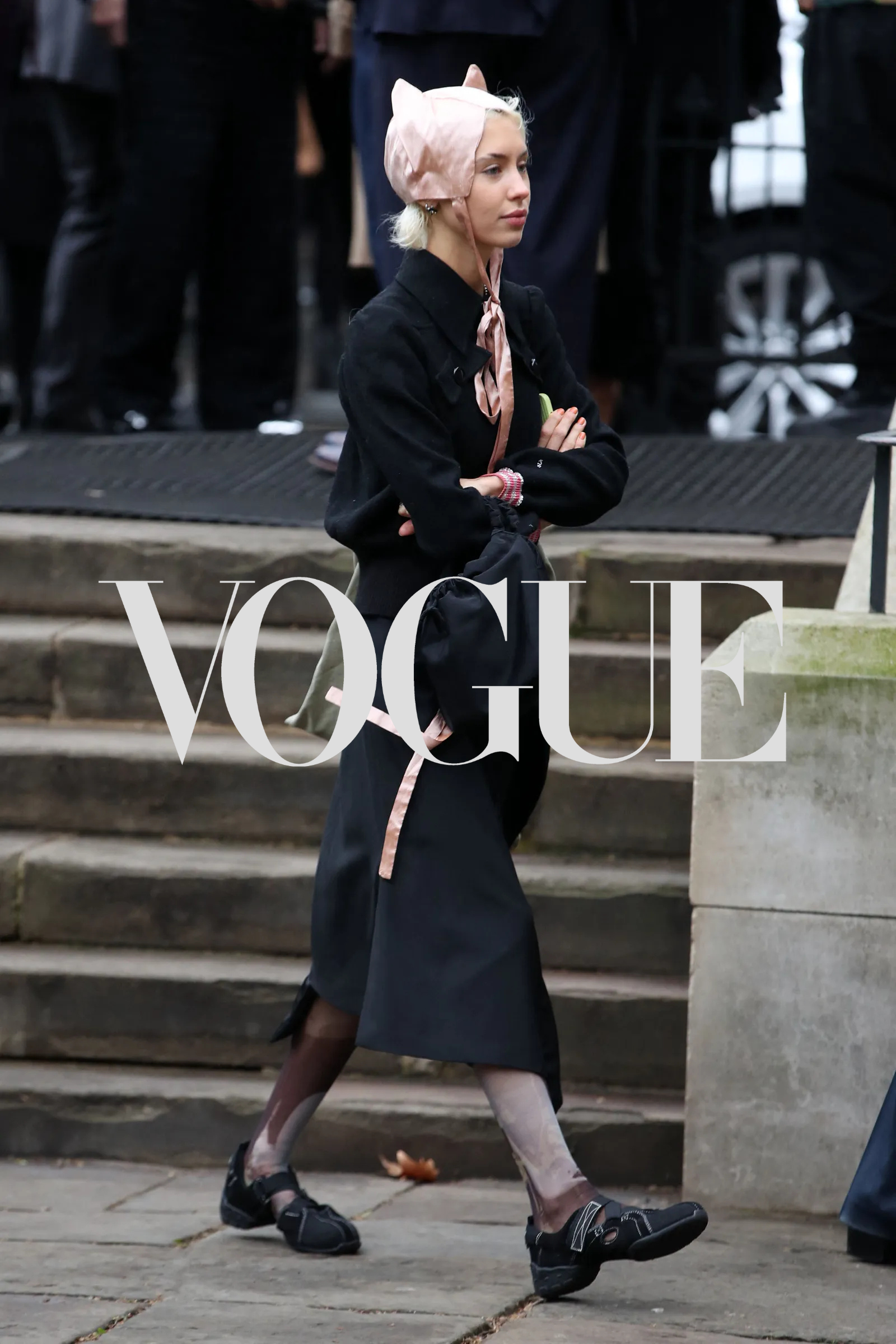
Iris and I have mutual friends, and she saw my kitty cat hat on one of their Instagrams. She asked for it and wore it because she liked it. I didn’t even know until I saw the public photos. She’s such a kind person, and I’m grateful for the visibility she gave me, even though it wasn’t planned at all.
You’re releasing a new collection. What else is in the pipeline for Be Nina?
Be Nina is expanding! We have exciting collaborations, including one with a bag designer and another involving perfume. We’re also growing our presence in stores worldwide. I don’t like to plan too much, everything with Be Nina has happened so naturally. This brand has already surprised me so much. I’d love to ask you, what do you expect from Be Nina? Maybe the answer is right there.
Words by Upasana Das
VOGUE Emerging Designers
Neo-Gothic aesthetics and Apulian textile traditions coexist in Be Nina, a cosmopolitan fashion brand based in the port of Brindisi. Its founder, Sabrina Bonatesta, tells us more.
Those born near a port are used to seeing people leave, to living with the awareness that every kind of journey can be an opportunity to grow and mature. Near a port, the horizon is always within sight and leaving home does not seem so difficult. Similarly, from the quay, one is also used to seeing people return, bringing with them all the experiences they have had elsewhere. Sabrina Bonatesta, a young designer from Brindisi who runs her brand, Be Nina, in a studio overlooking her city's port, knows this well: “Every time I come back from a trip, I find peace here. I can process the stimuli, the encounters, the conversations I've had around the world,” Sabrina begins to tell me from her rooftop terrace overlooking the sea, fishing boats, boats, and ships. “Since I came back to Brindisi, I feel like I'm floating in time and space. Or maybe I should say drifting. The pace is far from the hustle and bustle of big cities, and the scope of action around me is much wider. Plus, my loved ones are here, and the sun almost always shines, something I've learned not to take for granted (laughs, ed.).”
However, Be Nina's story began far from home. After graduating, Sabrina left Brindisi for London: “As soon as I arrived, I took a preparatory course for English university. At that time, I still thought I would become an accountant when I grew up; it was one of my teachers who steered me towards this sector,” she confesses. "Immediately afterwards, I enrolled in the Fashion Design course at Ravensbourne University. It was a very practical university: we carried out lots of projects and during those years I began to take inspiration from fashion books for my work and my personal style.“ In London's libraries, Sabrina's curiosity was fed by fashion history from all over the world: ”I was particularly interested in 19th-century England, the Victorian era, and neo-Gothic aesthetics. In addition, thanks to a friend of mine, I learned about various Japanese subcultures that had a particular influence on me. What's more, my sewing teacher had worked as a seamstress for Alexander McQueen for 11 years and told us wonderful stories about what went on behind the scenes in this profession. I felt like a sponge, going to historic shops, looking at books and films, absorbing everything. In this way, I also got to know myself better.
Consequently, the idea of creating Be Nina also dates back to her university years: "It all started with an academic project. At first, it was called Binina, after the nickname my brothers gave me as a child, which is also my nickname on social media. Then someone pointed out that Be Nina would work better internationally, so I changed it. That's how the idea started, but at that point I also wanted to understand what it meant to work for others.“ And suddenly, London no longer felt like the fertile ground that had allowed Sabrina to grow: ”All those stimuli had become too much at a certain point. I needed a quieter environment.“ So the designer left the English capital and flew to Alghero, where she started working in Antonio Marras' team: ”I learned a lot from Antonio and his seamstresses. The environment was very familiar, but even in Sardinia I felt I wasn't in the right place. It was in early 2020, when Covid broke out, that I decided to go home."
And then there was AltaRoma, Milan Fashion Week. The first campaigns, pop-ups around the world, from London to Tokyo to Seoul. The cover of Rolling Stone Italia with Rose Villain and Madame's concerts. In 2024, Be Nina was among the finalists for the Camera Moda Fashion Trust. "Even far from the big cities, you can make contacts. After all, nowadays all you need is an email. I would like people from Puglia who want to work in fashion to start understanding that you don't have to leave to do business. All my suppliers are within driving distance, for example (she smiles, ed.)." Within a few years, Be Nina's popularity has grown worldwide, especially in the United Kingdom, Japan, and South Korea: "The best-selling product is undoubtedly the ear hat, which has been worn by Iris Law and is loved by customers of all ages. I've noticed that many of them are creatives, artists, and influencers. Until now, I've worked hard on building an aesthetic, but now I want to focus even more on the product."
Despite her international success, however, Sabrina Bonatesta intends to stay in Brindisi: “I am grateful to be able to travel a lot with my work, but this is where I feel I want to continue to grow, together with Be Nina.” After all, there's no place like home.
by Valentina Abate
Manibus International Award 2025
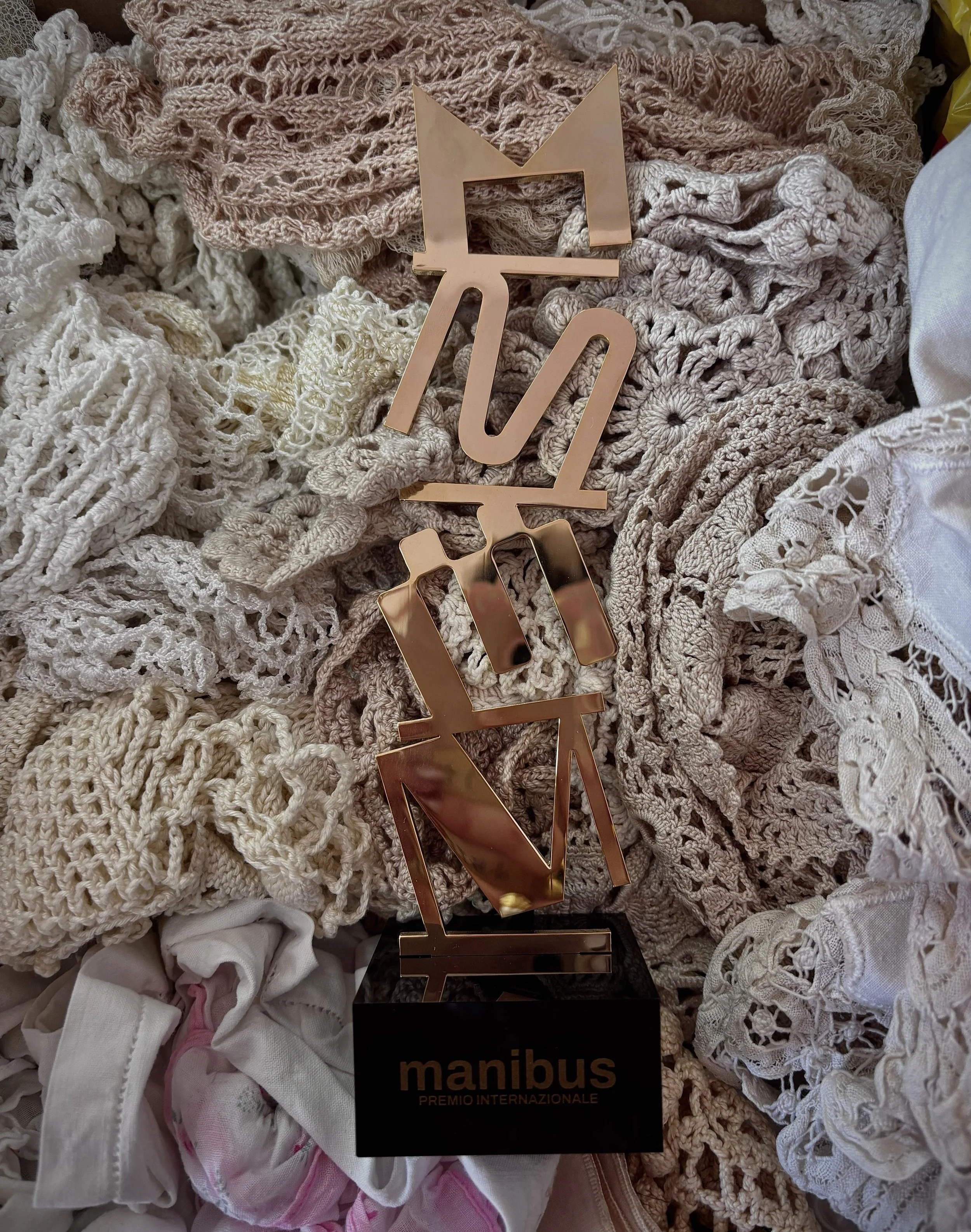
Each year during the MANIBUS® Ceremony, the MANIBUS® International Award Judging Committee is called upon to award the now highly coveted Prize, one of the most prestigious accolades in the contemporary fabric arts market.
This year, the MANIBUS® Award goes to Sabrina Bonatesta @howtobenina, designer of @binina, for the cosmopolitan vision that inspires her designs, a surprising blend of multicultural influences and time-honored artisanal craftsmanship.
For her ethical focus on environmental sustainability, which breathes new life into upcycled materials, redesigned with a modern twist, for unique sartorial creations.
Credits:
Project by Nicola Miulli Creations srl - Artistic Direction: Nicola Miulli - http://nicolamiulli.com @nicolamiulliofficial
Copyright © 2025 Nicola Miulli Creations srl - All rights reserved
Event co-financed by:
Puglia Region @weareinpuglia
Puglia promotion @pugliapromozione_aret